Showing posts with label Presidents. Show all posts

Friday, January 20, 2017

Thursday, September 4, 2014

George W. Bush: The Presidents

George Walker Bush was born in New Haven, Connecticut, at Grace-New Haven Hospital (now Yale – New Haven Hospital), on July 6, 1946, the first child of George Herbert Walker Bush and Barbara Pierce. He was raised in Midland and Houston, Texas, with four siblings, Jeb, Neil, Marvin and Dorothy. Another younger sister, Robin, died from leukemia at the age of three in 1953. Bush's grandfather, Prescott Bush, was a U.S. Senator from Connecticut. Bush's father, George H. W. Bush, was Vice President from 1981 to 1989 and President from 1989 to 1993. Bush has English and some German ancestry, along with more distant Dutch, Welsh, Irish, French, and Scottish roots.

Bush attended public schools in Midland, Texas, until the family moved to Houston after he completed seventh grade. He then went to The Kinkaid School, a prep school in Houston, for two years.

Bush finished high school at Phillips Academy, a boarding school (then all-male) in Andover, Massachusetts, where he played baseball and during his senior year was the head cheerleader. Bush attended Yale University from 1964 to 1968, graduating with an B.A. in history. During this time, he was a cheerleader and a member of the Delta Kappa Epsilon, being elected the fraternity's president during his senior year. Bush also became a member of the Skull and Bones society as a senior. Bush was a rugby union player and was on Yale's 1st XV. He characterized himself as an average student. His average during his first three years at Yale was 77 and he had a similar average under a nonnumeric rating system in his final year.

Beginning in the fall of 1973, Bush attended the Harvard Business School, where he earned a Master of Business Administration. He is the only U.S. President to have earned an M.B.A.

In May 1968, Bush was commissioned into the Texas Air National Guard. After two years of active-duty service while training, he was assigned to Houston, flying Convair F-102s with the 147th Reconnaissance Wing out of Ellington Field Joint Reserve Base. Critics, including former Democratic National Committee Chairman Terry McAuliffe, have alleged that Bush was favorably treated due to his father's political standing as a member of the House of Representatives, citing his selection as a pilot despite his low pilot aptitude test scores and his irregular attendance. In June 2005, the United States Department of Defense released all the records of Bush's Texas Air National Guard service, which remain in its official archives.

In late 1972 and early 1973, he drilled with the 187th Fighter Wing of the Alabama Air National Guard, having moved to Montgomery, Alabama to work on the unsuccessful U.S. Senate campaign of Republican Winton M. Blount. In 1972, Bush was suspended from flying for failure to take a scheduled physical exam. He was honorably discharged from the Air Force Reserve on November 21, 1974.

At a backyard barbecue in 1977, friends introduced him to Laura Lane Welch, a school teacher and librarian. Bush proposed to her after a three-month courtship, and they married on November 5 of that year. The couple settled in Midland, Texas. Bush left his family's Episcopal Church to join his wife's United Methodist Church. On November 25, 1981, Laura Bush gave birth to fraternal twin daughters, Barbara Pierce Bush and Jenna Welch Bush; they graduated from high school in 2000 and from Yale University and the University of Texas at Austin, respectively, in 2004.

In 1978, Bush ran for the House of Representatives from Texas's 19th congressional district. His opponent, Kent Hance, portrayed him as out of touch with rural Texans. Bush lost the election by 6,000 votes (6%) of the 103,000 votes cast. He returned to the oil industry and began a series of small, independent oil exploration companies. He created Arbusto Energy, and later changed the name to Bush Exploration. In 1984, his company merged with the larger Spectrum 7, and Bush became chairman. The company was hurt by decreased oil prices, and it folded into HKN, Inc. Bush served on the board of directors for HKN. Questions of possible insider trading involving HKN arose, but the Securities and Exchange Commission's (SEC) investigation concluded that the information Bush had at the time of his stock sale was not sufficient to constitute insider trading.

Bush moved his family to Washington, D.C. in 1988 to work on his father's campaign for the U.S. presidency. He served as a campaign adviser and liaison to the media; he assisted his father by campaigning across the country. Returning to Texas after the successful campaign, he purchased a share in the Texas Rangers baseball franchise in April 1989, where he served as managing general partner for five years. He actively led the team's projects and regularly attended its games, often choosing to sit in the open stands with fans. Bush's sale of his shares in the Rangers in 1998 brought him over $15 million from his initial $800,000 investment.

In December 1991, Bush was one of seven people named by his father to run his father's 1992 Presidential re-election campaign as "campaign advisor". The prior month, his father asked him to tell White House chief of staff John H. Sununu that he should resign.

As Bush's brother, Jeb, sought the governorship of Florida, Bush declared his candidacy for the 1994 Texas gubernatorial election. His campaign focused on four themes: welfare reform, tort reform, crime reduction, and education improvement. Bush's campaign advisers were Karen Hughes, Joe Allbaugh, and Karl Rove.

After easily winning the Republican primary, Bush faced popular Democratic incumbent Governor Ann Richards. In the course of the campaign, Bush pledged to sign a bill allowing Texans to obtain permits to carry concealed weapons. Richards had vetoed the bill, but Bush signed it after he became governor. According to The Atlantic Monthly, the race "featured a rumor that she was a lesbian, along with a rare instance of such a tactic's making it into the public record – when a regional chairman of the Bush campaign allowed himself, perhaps inadvertently, to be quoted criticizing Richards for 'appointing avowed homosexual activists' to state jobs". The Atlantic, and others, connected the lesbian rumor to Karl Rove, but Rove denied being involved. Bush won the general election with 53.5% against Richards' 45.9%.

In June 1999, while Governor of Texas, Bush announced his candidacy for President of the United States. With no incumbent running, Bush entered a large field of candidates for the Republican Party presidential nomination consisting of John McCain, Alan Keyes, Steve Forbes, Gary Bauer, Orrin Hatch, Elizabeth Dole, Dan Quayle, Pat Buchanan, Lamar Alexander, John Kasich, and Robert C. Smith.
Bush portrayed himself as a compassionate conservative, implying he was more centrist than other Republicans. He campaigned on a platform that included bringing integrity and honor back to the White House, increasing the size of the United States Armed Forces, cutting taxes, improving education, and aiding minorities. By early 2000, the race had centered on Bush and McCain.

Bush won the Iowa caucuses, but, although he was heavily favored to win the New Hampshire primary, he trailed McCain by 19% and lost that primary. Despite this, Bush regained momentum and, according to political observers, effectively became the front runner after the South Carolina primary, which according to The Boston Globe made history for his campaign's negativity; The New York Times described it as a smear campaign.

On July 25, 2000, Bush surprised some observers by asking Dick Cheney, a former White House Chief of Staff, U.S. Representative, and Secretary of Defense, to be his running mate. Cheney was then serving as head of Bush's Vice-Presidential search committee. Soon after, Cheney was officially nominated by the Republican Party at the 2000 Republican National Convention.

Bush continued to campaign across the country and touted his record as Governor of Texas. Bush's campaign criticized his Democratic opponent, incumbent Vice President Al Gore, over gun control and taxation.

When the election returns came in on November 7, Bush won 29 states, including Florida. The closeness of the Florida outcome led to a recount. The initial recount also went to Bush, but the outcome was tied up in courts for a month until reaching the U.S. Supreme Court. On December 9, in a controversial ruling the Bush v. Gore case the Court reversed a Florida Supreme Court decision ordering a third count, and stopped an ordered statewide hand recount based on the argument that the use of different standards among Florida's counties violated the Equal Protection Clause of the Fourteenth Amendment. The machine recount showed that Bush had won the Florida vote by a margin of 537 votes out of six million cast. Although he received 543,895 fewer individual votes than Gore nationwide, Bush won the election, receiving 271 electoral votes to Gore's 266.

In 2004, Bush commanded broad support in the Republican Party and did not encounter a primary challenge. He appointed Ken Mehlman as campaign manager, with a political strategy devised by Karl Rove. Bush and the Republican platform included a strong commitment to the wars in Iraq and Afghanistan, support for the USA PATRIOT Act, a renewed shift in policy for constitutional amendments banning abortion and same-sex marriage, reforming Social Security to create private investment accounts, creation of an ownership society, and opposing mandatory carbon emissions controls, Bush also called for the implementation of a guest worker program for immigrants, which was criticized by conservatives.

In the election, Bush carried 31 of 50 states, receiving a total of 286 electoral votes. He won an outright majority of the popular vote (50.7% to his opponent's 48.3%). The previous President to win an outright majority of the popular vote was Bush's father in the 1988 election. Additionally, it was the first time since Herbert Hoover's election in 1928 that a Republican president was elected alongside re-elected Republican majorities in both Houses of Congress.

Though Bush originally outlined an ambitious domestic agenda, his priorities were significantly altered following the September 11 terrorist attacks in 2001. Wars were waged in Afghanistan and Iraq with significant domestic debates regarding immigration, healthcare, Social Security, economic policy, and treatment of terrorist detainees. Over an eight-year period, Bush's once-high approval ratings steadily declined, while his disapproval numbers increased significantly. In 2007, the United States entered the longest post-World War II recession.

Bush took office during a period of economic recession in the wake of the bursting of the Dot-com bubble. The terrorist attacks also impacted the economy. The Bush administration increased federal government spending from $1.789 trillion to $2.983 trillion (60%) while revenues increased from $2.025 trillion to $2.524 trillion (from 2000 to 2008). Individual income tax revenues increased by 14%, corporate tax revenues by 50%, customs and duties by 40%. Discretionary defense spending was increased by 107%, discretionary domestic spending by 62%, Medicare spending by 131%, social security by 51%, and income security spending by 130%. Cyclically adjusted, revenues rose by 35% and spending by 65%.

The increase in spending was more than under any predecessor since Lyndon B. Johnson. The number of economic regulation governmental workers increased by 91,196.

The surplus in fiscal year 2000 was $237 billion - the third consecutive surplus and the largest surplus ever. In 2001, Bush's budget estimated that there would be a $5.6 trillion surplus over the next ten years. Facing congressional opposition, Bush held townhall style meetings across the U.S. in order to increase public support for his plan for a $1.35 trillion tax cut program - one of the largest tax cuts in U.S. history. Bush argued that unspent government funds should be returned to taxpayers, saying "the surplus is not the government’s money. The surplus is the people’s money." Federal Reserve Chairman Alan Greenspan warned of a recession and Bush stated that a tax cut would stimulate the economy and create jobs. Treasury Secretary Paul O'Neill, opposed some of the tax cuts on the basis that they would contribute to budget deficits and undermine Social Security. O'Neill disputes the claim, made in Bush's book Decision Points, that he never openly disagreed with him on planned tax cuts. By 2003, the economy showed signs of improvement, though job growth remained stagnant. Another tax cut program was passed that year.

Unemployment originally rose from 4.2% in January 2001 to 6.3% in June 2003, but subsequently dropped to 4.5% as of July 2007. Adjusted for inflation, median household income dropped by $1,175 between 2000 and 2007, while Professor Ken Homa of Georgetown University has noted that "after-tax median household income increased by 2%" The poverty rate increased from 11.3% in 2000 to 12.3% in 2006 after peaking at 12.7% in 2004. By October 2008, due to increases in spending, the national debt had risen to $11.3 trillion, an increase of over 100% from 2000 when the debt was only $5.6 trillion. Most debt was accumulated as a result of what became known as the "Bush tax cuts" and increased national security spending. In March 2006, then-Senator Barack Obama said when he voted against raising the debt ceiling: "The fact that we are here today to debate raising America’s debt limit is a sign of leadership failure." By the end of Bush's presidency, unemployment climbed to 7.2%.

Many economists and world governments determined that the situation became the worst financial crisis since the Great Depression. Additional regulation over the housing market would have been beneficial, according to former Federal Reserve Chairman Alan Greenspan. Bush, meanwhile, proposed a financial rescue plan to buy back a large portion of the U.S. mortgage market. Vince Reinhardt, a former Federal Reserve economist now at the American Enterprise Institute, said "it would have helped for the Bush administration to empower the folks at Treasury and the Federal Reserve and the comptroller of the currency and the FDIC to look at these issues more closely", and additionally, that it would have helped "for Congress to have held hearings".

In November 2008, over 500,000 jobs were lost, which marked the largest loss of jobs in the United States in 34 years. The Bureau of Labor Statistics reported that in the last four months of 2008, 1.9 million jobs were lost. By the end of 2008, the U.S. had lost a total of 2.6 million jobs.

In 2006, Bush urged Congress to allow more than 12 million illegal immigrants to work in the United States with the creation of a "temporary guest-worker program". Bush did not support amnesty for illegal immigrants, but argued that the lack of legal status denies the protections of U.S. laws to millions of people who face dangers of poverty and exploitation, and penalizes employers despite a demand for immigrant labor. Nearly 8 million immigrants came to the United States from 2000 to 2005, more than in any other five-year period in the nation's history. Almost half entered illegally.

Bush also urged Congress to provide additional funds for border security and committed to deploying 6,000 National Guard troops to the Mexico–United States border. In May–June 2007, Bush strongly supported the Comprehensive Immigration Reform Act of 2007, which was written by a bipartisan group of Senators with the active participation of the Bush administration. The bill envisioned a legalization program for illegal immigrants, with an eventual path to citizenship; establishing a guest worker program; a series of border and work site enforcement measures; a reform of the green card application process and the introduction of a point-based "merit" system for green cards; elimination of "chain migration" and of the Diversity Immigrant Visa; and other measures. Bush contended that the proposed bill did not amount to amnesty.

During his Presidential campaign, Bush's foreign policy platform included support for stronger economic and political relationship with Latin America, especially Mexico, and a reduction of involvement in "nation-building" and other small-scale military engagements. The administration pursued a national missile defense. Bush was an advocate of China's entry into the World Trade Organization.

In his 2002 State of the Union Address, Bush referred to an axis of evil including Iraq, Iran and North Korea. After the September 11 attacks on New York, Bush launched the War on Terror, in which the United States military and a small international coalition invaded Afghanistan, the location of Osama Bin Laden, who planned the New York attacks. In 2003, Bush then launched the invasion of Iraq, searching for Weapons of Mass Destruction, which he described as being part of the War on Terrorism. Those invasions led to the toppling of the Taliban regime in Afghanistan and the removal of Saddam Hussein from power in Iraq.

Midway through Bush's second term, it was questioned whether Bush was retreating from his freedom and democracy agenda, highlighted in policy changes toward some oil-rich former Soviet republics in central Asia.

The September 11 terrorist attacks were a major turning point in Bush's presidency. That evening, he addressed the nation from the Oval Office, promising a strong response to the attacks. He also emphasized the need for the nation to come together and comfort the families of the victims. On September 14, he visited Ground Zero, meeting with Mayor Rudy Giuliani, firefighters, police officers, and volunteers. Bush addressed the gathering via a megaphone while standing on a heap of rubble, to much applause: "I can hear you. The rest of the world hears you. And the people who knocked these buildings down will hear all of us soon."

In a September 20 speech, Bush condemned Osama bin Laden and his organization Al-Qaeda, and issued an ultimatum to the Taliban regime in Afghanistan, where bin Laden was operating, to "hand over the terrorists, or ... share in their fate"

After September 11, Bush announced a global War on Terror. The Afghan Taliban regime was not forthcoming with Osama bin Laden, so Bush ordered the invasion of Afghanistan to overthrow the Taliban regime. In his January 29, 2002 State of the Union Address, he asserted that an "axis of evil" consisting of North Korea, Iran, and Iraq was "arming to threaten the peace of the world" and "pose[d] a grave and growing danger". The Bush Administration asserted both a right and the intention to wage preemptive war, or preventive war. This became the basis for the Bush Doctrine which weakened the unprecedented levels of international and domestic support for the United States which had followed the September 11 attacks.

Dissent and criticism of Bush's leadership in the War on Terror increased as the war in Iraq continued. In 2006, a National Intelligence Estimate concluded that the Iraq War had become the "cause célèbre for jihadists".

Bush authorized the CIA to use waterboarding as one of several enhanced interrogation techniques. Between 2002 and 2003 the CIA considered certain enhanced interrogation techniques, such as waterboarding, to be legal based on a secret Justice Department legal opinion arguing that terror detainees were not protected by the Geneva Conventions' ban on torture and Vice President Cheney said enhanced interrogation including waterboarding was not torture or illegal. The CIA had exercised the technique on certain key terrorist suspects under authority given to it in the Bybee Memo from the Attorney General, though that memo was later withdrawn. While not permitted by the U.S. Army Field Manuals which assert "that harsh interrogation tactics elicit unreliable information", the Bush administration believed these enhanced interrogations "provided critical information" to preserve American lives. Critics, such as former CIA officer Bob Baer, have stated that information was suspect, "you can get anyone to confess to anything if the torture's bad enough."

On October 17, 2006, Bush signed into law the Military Commissions Act of 2006, a law enacted in the wake of the Supreme Court's decision in Hamdan v. Rumsfeld, 548 U.S. 557 (2006), which allows the U.S. government to prosecute unlawful enemy combatants by military commission rather than a standard trial. The law also denies them access to habeas corpus and bars the torture of detainees, but allows the president to determine what constitutes torture.

On May 10, 2005, Vladimir Arutyunian, a native Georgian who was born to a family of ethnic Armenians, threw a live hand grenade toward a podium where Bush was speaking at Freedom Square in Tbilisi, Georgia. Georgian President Mikheil Saakashvili was seated nearby. It landed in the crowd about 65 feet (20 m) from the podium after hitting a girl, but it did not detonate. Arutyunian was arrested in July 2005, confessed, was convicted and was given a life sentence in January 2006.

Bush began his presidency with approval ratings near 50%. After the September 11 attacks, Bush gained an approval rating of 90%, maintaining 80–90% approval for four months after the attacks. It remained over 50% during most of his first term and then fell to as low as 19% in his second term.

Following the inauguration of Barack Obama, Bush and his family flew from Andrews Air Force Base to a homecoming celebration in Midland, Texas, following which they returned to their ranch in Crawford, Texas. They bought a home in the Preston Hollow neighborhood of Dallas, Texas, where they settled down.

He makes regular appearances at various events throughout the Dallas/Fort Worth area, most notably when he conducted the opening coin toss at the Dallas Cowboys first game in the team's new stadium in Arlington and an April 2009 visit to a Texas Rangers game, where he thanked the people of Dallas for helping him settle in and was met with a standing ovation. He also attended every home playoff game for the Texas Rangers 2010 season and, accompanied by his father, threw out the ceremonial first pitch at Rangers Ballpark in Arlington for Game 4 of the 2010 World Series on October 31, 2010.

On August 6, 2013, Bush was successfully treated for a coronary artery blockage with a stent. The blockage had been found during an annual medical examination.


"At one time, I believed George Walker Bush to be the worst president in our nation's history. Then along came Obama." - Carroll Bryant


Sources: Wikipedia

This work released through CC 3.0 BY-SA - Creative Commons


Thursday, August 7, 2014

Bill Clinton: The Presidents

William Jefferson "Bill" Clinton (born William Jefferson Blythe III, August 19, 1946) is an American politician who served from 1993 to 2001 as the 42nd President of the United States. Inaugurated at age 46, he was the third-youngest president. He took office at the end of the Cold War, and was the first president from the baby boomer generation. Clinton has been described as a New Democrat. Many of his policies have been attributed to a centrist Third Way philosophy of governance. Before becoming president, he was the Governor of Arkansas for five two-year terms, serving from 1979 to 1981 and from 1983 to 1992. He was also the state's Attorney General from 1977 to 1979.
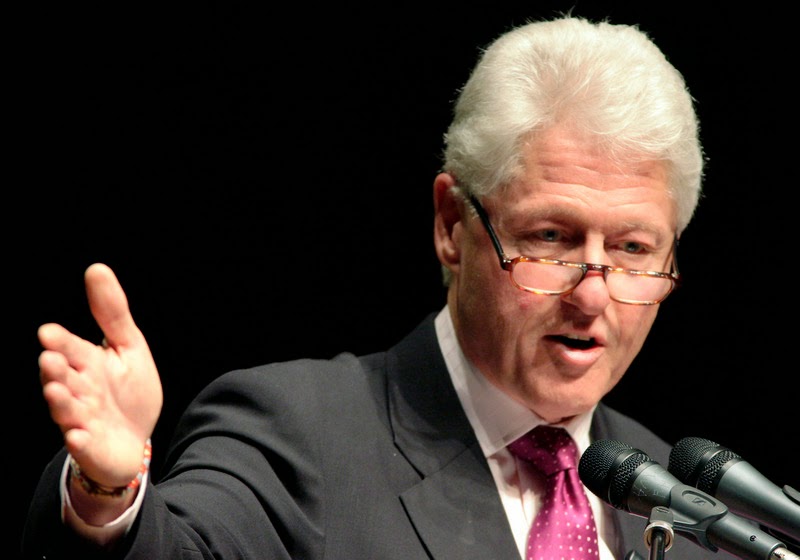
Clinton was born William Jefferson Blythe III on August 19, 1946, at Julia Chester Hospital in Hope, Arkansas. His father, William Jefferson Blythe, Jr. (1918–1946), was a traveling salesman who died in an automobile accident three months before Bill was born. His mother, Virginia Dell Cassidy (1923–1994), traveled to New Orleans to study nursing soon after he was born. She left Bill in Hope with her parents Eldridge and Edith Cassidy, who owned and ran a small grocery store. At a time when the Southern United States was segregated racially, Bill's grandparents sold goods on credit to people of all races. In 1950, Bill's mother returned from nursing school and married Roger Clinton, Sr., who owned an automobile dealership in Hot Springs, Arkansas, with his brother. The family moved to Hot Springs in 1950.

Although he assumed use of his stepfather's surname, it was not until Billy (as he was known then) turned fifteen that he formally adopted the surname Clinton as a gesture toward his stepfather. Clinton says he remembers his stepfather as a gambler and an alcoholic who regularly abused his mother and half-brother, Roger Clinton, Jr., to the point where he intervened multiple times with the threat of violence to protect them.

In Hot Springs, Bill attended St. John's Catholic Elementary School, Ramble Elementary School, and Hot Springs High School – where he was an active student leader, avid reader, and musician. Clinton was in the chorus and played the tenor saxophone, winning first chair in the state band's saxophone section. He briefly considered dedicating his life to music.

Clinton's interest in law also began in Hot Springs High, when in his Latin class he took up the challenge to argue the defense of the ancient Roman Senator Catiline in a mock trial. After a vigorous defense that made use of his "budding rhetorical and political skills", he told the Latin teacher Mrs. Elizabeth Buck that it "made him realize that someday he would study law."

Clinton has named two influential moments in his life that contributed to his decision to become a public figure, both occurring in 1963. One was his visit as a Boys Nation senator to the White House to meet President John F. Kennedy. The other was listening to Martin Luther King, Jr.'s 1963 I Have a Dream speech, which impressed him enough that he later memorized it.

After graduating from Yale Law School, Clinton returned to Arkansas and became a law professor at the University of Arkansas. A year later, he ran for the House of Representatives in 1974. The incumbent, Republican John Paul Hammerschmidt, defeated Clinton in the general election by a 52 percent to 48 percent margin. With only minor opposition in the primary and no opposition at all in the general election, Clinton was elected Arkansas Attorney General in 1976.
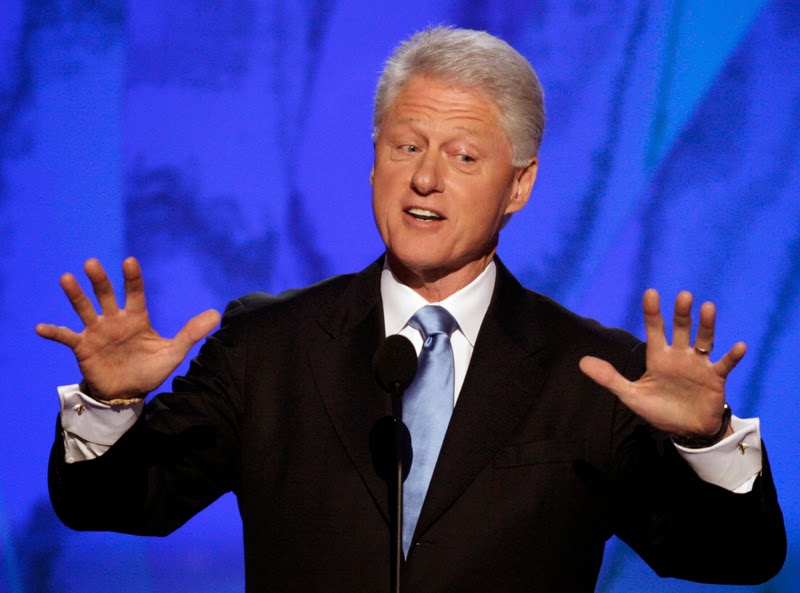
Clinton was elected Governor of Arkansas in 1978, having defeated the Republican candidate Lynn Lowe, a farmer from Texarkana. He became the youngest governor in the country at 32. Due to his youthful appearance, Clinton was often called the "Boy Governor", a referent that continues to be used to refer to him during his gubernatorial era on occasion. He worked on educational reform and Arkansas's roads, with wife Hillary leading a successful committee on urban health care reform. However, his term included an unpopular motor vehicle tax and citizens' anger over the escape of Cuban refugees (from the Mariel boatlift) detained in Fort Chaffee in 1980. Monroe Schwarzlose of Kingsland in Cleveland County, polled 31 percent of the vote against Clinton in the Democratic gubernatorial primary of 1980. Some suggested Schwarzlose's unexpected voter turnout foreshadowed Clinton's defeat in the general election that year by Republican challenger Frank D. White. As Clinton once joked, he was the youngest ex-governor in the nation's history.

Clinton joined friend Bruce Lindsey's Little Rock law firm of Wright, Lindsey and Jennings. In 1982, he was again elected governor and kept the office for ten years. Beginning with the 1986 election, Arkansas had changed its gubernatorial term of office from 2 to 4 years. During his term he helped transform Arkansas's economy and significantly improve the state's educational system. He became a leading figure among the New Democrats. The New Democrats, organized as the Democratic Leadership Council (DLC), were a branch of the Democratic Party that called for welfare reform and smaller government, a policy supported by both Democrats and Republicans. He gave the Democratic response to President Reagan's 1985 State of the Union Address and served as Chair of the National Governors Association from 1986 to 1987, bringing him to an audience beyond Arkansas. Clinton made economic growth, job creation and educational improvement high priorities. For senior citizens, he removed the sales tax from medications and increased the home property-tax exemption.

In the early 1980s, Clinton made reform of the Arkansas education system a top priority. The Arkansas Education Standards Committee, chaired by Clinton's wife, attorney and Legal Services Corporation chair Hillary Rodham Clinton, succeeded in reforming the education system, transforming it from the worst in the nation into one of the best. Many have considered this the greatest achievement of the Clinton governorship. Clinton and the committee were responsible for state educational improvement programs, notably more spending for schools, rising opportunities for gifted children, an increase in vocational education, raising of teachers' salaries, inclusion of a wider variety of courses, and compulsory teacher testing for aspiring educators. He defeated four Republican candidates for governor: Lowe (1978), White (1982 and 1986), and businessmen Woody Freeman of Jonesboro, (1984) and Sheffield Nelson of Little Rock (1990).

The Clintons' personal and business affairs during the 1980s included transactions that became the basis of the Whitewater controversy investigation that later dogged his presidential administration. After extensive investigation over several years, no indictments were made against the Clintons related to the years in Arkansas.

According to some sources, Clinton was in his early years a death penalty opponent who switched positions. During Clinton's term, Arkansas performed its first executions since 1964 (the death penalty had been re-enacted on March 23, 1973). As Governor, he oversaw four executions: one by electric chair and three by lethal injection. Later, as president, Clinton was the first President to pardon a death-row inmate since the federal death penalty was reintroduced in 1988.

In 1987, there was media speculation Clinton would enter the race after then-New York Governor Mario Cuomo declined to run and Democratic front-runner Gary Hart withdrew owing to revelations of marital infidelity. Clinton decided to remain as Arkansas governor (following consideration for the potential candidacy of Hillary Rodham Clinton for governor, initially favored – but ultimately vetoed – by the First Lady). For the nomination, Clinton endorsed Massachusetts Governor Michael Dukakis. He gave the nationally televised opening night address at the 1988 Democratic National Convention, but his speech, which was 33 minutes long and twice as long as it was expected to be, was criticized for being too long and poorly delivered. Presenting himself as a moderate and a member of the New Democrat wing of the Democratic Party, he headed the moderate Democratic Leadership Council in 1990 and 1991.
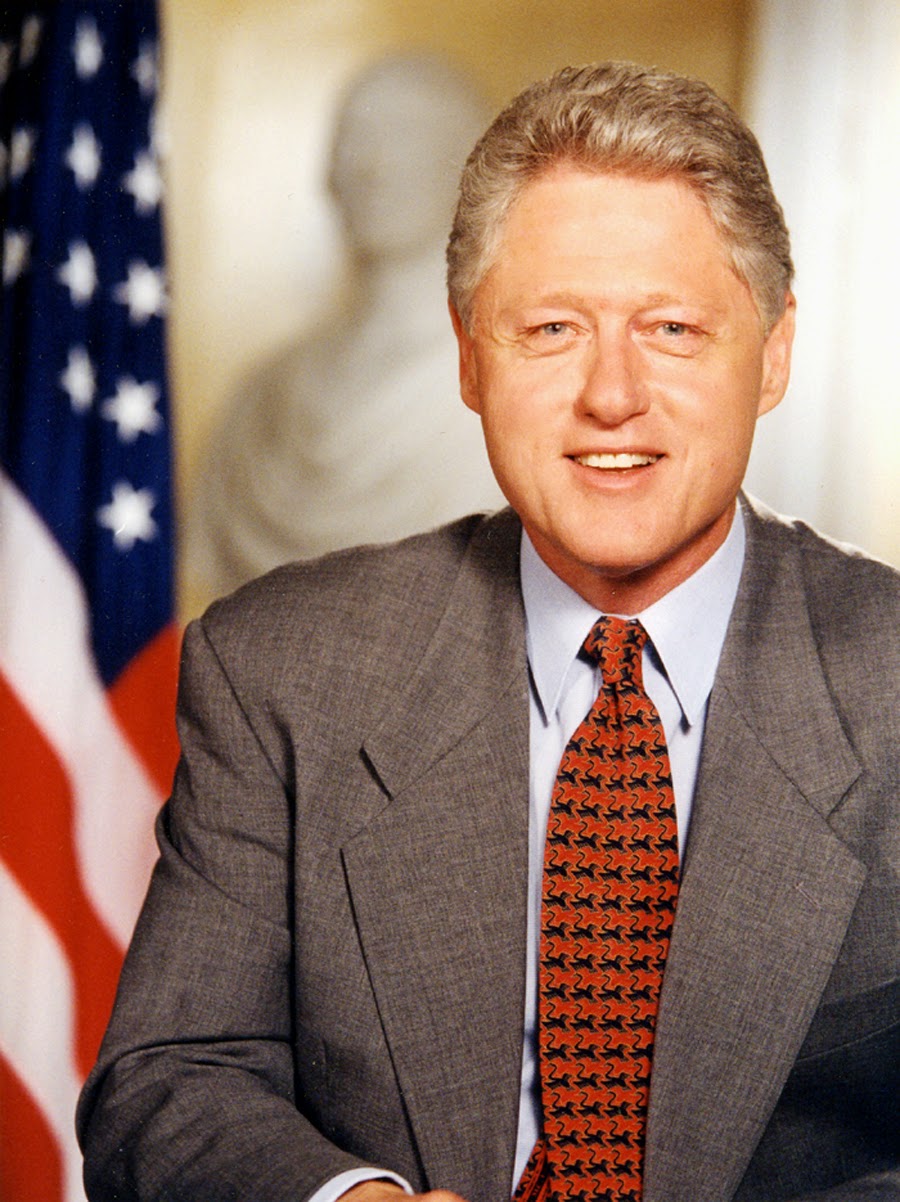
In the first primary contest, the Iowa caucus, Clinton finished a distant third to Iowa Senator Tom Harkin. During the campaign for the New Hampshire primary, reports of an extramarital affair with Gennifer Flowers surfaced. As Clinton fell far behind former Massachusetts Senator Paul Tsongas in the New Hampshire polls, following Super Bowl XXVI, Clinton and his wife Hillary went on 60 Minutes to rebuff the charges. Their television appearance was a calculated risk, but Clinton regained several delegates. He finished second to Tsongas in the New Hampshire primary, but after trailing badly in the polls and coming within single digits of winning, the media viewed it as a victory. News outlets labeled him "The Comeback Kid" for earning a firm second-place finish.

Winning the big prizes of Florida and Texas and many of the Southern primaries on Super Tuesday gave Clinton a sizable delegate lead. However, former California Governor Jerry Brown was scoring victories and Clinton had yet to win a significant contest outside his native South. With no major Southern state remaining, Clinton targeted New York, which had many delegates. He scored a resounding victory in New York City, shedding his image as a regional candidate. Having been transformed into the consensus candidate, he secured the Democratic Party nomination, finishing with a victory in Jerry Brown's home state of California.

Because Bush's approval ratings were around 80 percent during the Gulf War, he was described as unbeatable. However, when Bush compromised with Democrats to try to lower Federal deficits, he reneged on his promise not to raise taxes, hurting his approval rating. Clinton repeatedly condemned Bush for making a promise he failed to keep. By election time, the economy was souring and Bush saw his approval rating plummet to just slightly over 40 percent. Finally, conservatives were previously united by anti-communism, but with the end of the Cold War, the party lacked a uniting issue. When Pat Buchanan and Pat Robertson addressed Christian themes at the Republican National Convention – with Bush criticizing Democrats for omitting God from their platform – many moderates were alienated. Clinton then pointed to his moderate, "New Democrat" record as governor of Arkansas, though some on the more liberal side of the party remained suspicious. Many Democrats who had supported Ronald Reagan and Bush in previous elections switched their support to Clinton. Clinton and his running mate, Al Gore, toured the country during the final weeks of the campaign, shoring up support and pledging a "new beginning".

Clinton won the 1992 presidential election (43.0 percent of the vote) against Republican incumbent George H. W. Bush (37.4 percent of the vote) and billionaire populist Ross Perot, who ran as an independent (18.9 percent of the vote) on a platform focusing on domestic issues; a significant part of Clinton's success was Bush's steep decline in public approval. Clinton's election ended twelve years of Republican rule of the White House and twenty of the previous twenty-four years. The election gave Democrats full control of the United States Congress, the first time one party controlled both the executive and legislative branches since Democrats held the 95th United States Congress during the Jimmy Carter presidency in the late 1970s.

During his presidency, Clinton advocated for a wide variety of legislation and programs, much of which was enacted into law or was implemented by the executive branch. Some of his policies, such as the North American Free Trade Agreement and welfare reform, have been attributed to a centrist Third Way philosophy of governance, while on other issues his stance was left-of-center. On budgetary matters his policy of fiscal conservatism helped to reduce deficits. Clinton presided over the longest period of peacetime economic expansion in American history. The Congressional Budget Office reported budget surpluses of $69 billion in 1998, $126 billion in 1999, and $236 billion in 2000, during the last three years of Clinton's presidency. At the end of his presidency, Clinton moved to New York and helped his wife win election to the U.S. Senate there.
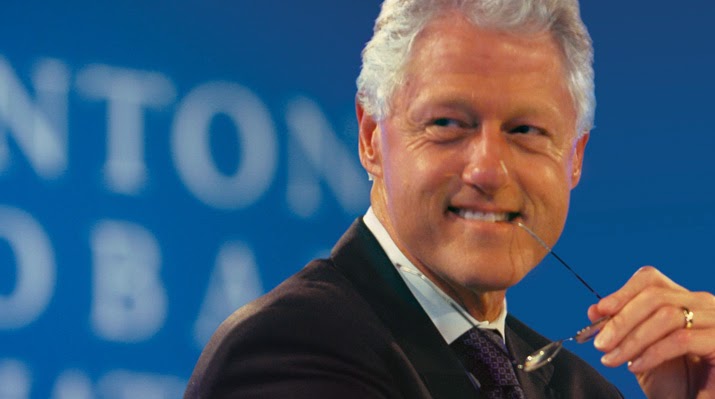
Clinton was inaugurated as the 42nd President of the United States on January 20, 1993. Shortly after taking office, Clinton signed the Family and Medical Leave Act of 1993 on February 5, which required large employers to allow employees to take unpaid leave for pregnancy or a serious medical condition. This action had bipartisan support, and proved quite popular with the public.

On February 15, 1993, Clinton made his first address to the nation, announcing his plan to raise taxes to cap the budget deficit. Two days later, in a nationally televised address to a joint session of Congress, Clinton unveiled his economic plan. The plan focused on reducing the deficit rather than on cutting taxes for the middle class, which had been high on his campaign agenda. Clinton's advisers pressured him to raise taxes on the theory that a smaller federal budget deficit would reduce bond interest rates.

On May 19, 1993, Clinton fired seven employees of the White House Travel Office, causing the White House travel office controversy even though the Travel Office staff served at the pleasure of the President, who could dismiss them without cause. The White House responded to the controversy by claiming the firings were done because of financial improprieties that had been revealed by a brief FBI investigation. Critics contended the firings had been done to allow friends of the Clintons to take over the travel business and that the involvement of the FBI was unwarranted.

Clinton signed the Omnibus Budget Reconciliation Act of 1993 in August of that year, which passed Congress without a Republican vote. It cut taxes for fifteen million low-income families, made tax cuts available to 90 percent of small businesses, and raised taxes on the wealthiest 1.2 percent of taxpayers. Additionally, through the implementation of spending restraints, it mandated the budget be balanced over a number of years.

Clinton made a major speech to Congress regarding a health care reform plan on September 22, 1993, aimed at achieving universal coverage through a national health care plan. This was one of the most prominent items on Clinton's legislative agenda, and resulted from a task force headed by Hillary Clinton. Though at first well received in political circles, it was eventually doomed by well-organized opposition from conservatives, the American Medical Association, and the health insurance industry. However, John F. Harris, a biographer of Clinton's, states the program failed because of a lack of coordination within the White House. Despite the Democratic majority in Congress, the effort to create a national health care system ultimately died when compromise legislation by George J. Mitchell failed to gain a majority of support in August 1994. It was the first major legislative defeat of Clinton's administration.

On January 1, 1994, Clinton signed the North American Free Trade Agreement into law. Throughout his first year in office, Clinton consistently supported ratification of the treaty by the U.S. Senate. Clinton and most of his allies in the Democratic Leadership Committee strongly supported free trade measures; there remained, however, strong disagreement within the party. Opposition came chiefly from anti-trade Republicans, protectionist Democrats and supporters of Ross Perot. The bill passed the house with 234 votes against 200 opposed (132 Republicans and 102 Democrats voting in favor; 156 Democrats, 43 Republicans, and 1 independent against). The treaty was then ratified by the Senate and signed into law by the President.
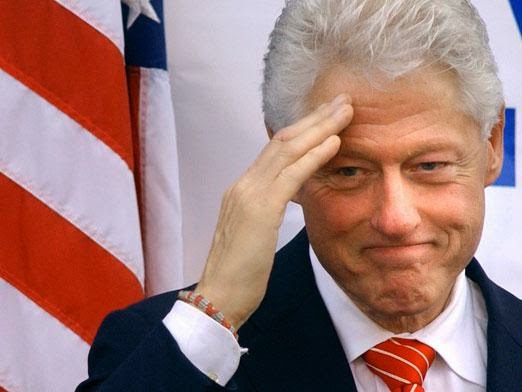
 
Clinton's 1994 Omnibus Crime Bill made many changes to U.S. law, including the expansion of the death penalty to include crimes not resulting in death, such as running a large-scale drug enterprise. During Clinton's re-election campaign he said, "My 1994 crime bill expanded the death penalty for drug kingpins, murderers of federal law enforcement officers, and nearly 60 additional categories of violent felons."

The Clinton administration also launched the first official White House website, whitehouse.gov, on October 21, 1994. It was followed by three more versions, resulting in the final edition launched in 2000. The White House website was part of a wider movement of the Clinton administration toward web-based communication. According to Robert Longley, "Clinton and Gore were responsible for pressing almost all federal agencies, the U.S. court system and the U.S. military onto the Internet, thus opening up America's government to more of America's citizens than ever before. On July 17, 1996, Clinton issued Executive Order 13011 – Federal Information Technology, ordering the heads of all federal agencies to utilize information technology fully to make the information of the agency easily accessible to the public."

After two years of Democratic Party control, the Democrats lost control of Congress in the mid-term elections in 1994, for the first time in forty years.

In the 1996 presidential election, Clinton was re-elected, receiving 49.2 percent of the popular vote over Republican Bob Dole (40.7 percent of the popular vote) and Reform candidate Ross Perot (8.4 percent of the popular vote), becoming the first Democratic incumbent since Lyndon Johnson to be elected to a second term and the first Democrat since Franklin D. Roosevelt to be elected President more than once. The Republicans lost a few seats in the House and gained a few in the Senate, but retained control of both houses of the 105th United States Congress. Clinton received 379, or over 70 percent of the Electoral College votes, with Dole receiving 159 electoral votes.
 
In the January 1997 State of the Union address, Clinton proposed a new initiative to provide coverage to up to five million children. Senators Ted Kennedy – a Democrat – and Orrin Hatch – a Republican – teamed up with Hillary Rodham Clinton and her staff in 1997, and succeeded in passing legislation forming the State Children's Health Insurance Program (SCHIP), the largest (successful) health care reform in the years of the Clinton Presidency. That year, Hillary Clinton shepherded through Congress the Adoption and Safe Families Act and two years later she succeeded in helping pass the Foster Care Independence Act. He negotiated the passage of the Balanced Budget Act of 1997 by the Republican Congress. In October 1997, he announced he was getting hearing aids, due to hearing loss attributed to his age, and his time spent as a musician in his youth.
In a lame-duck session of Congress after the 1998 elections, the House voted to impeach Clinton, based on alleged acts of perjury and obstruction of justice related to the Lewinsky scandal. This made Clinton only the second U.S. president to be impeached (the first being Andrew Johnson).

Impeachment proceedings were based on allegations that Clinton had illegally lied about and covered up his relationship with 22-year-old White House intern Monica Lewinsky. After the Starr Report was submitted to the House providing what it termed "substantial and credible information that President Clinton Committed Acts that May Constitute Grounds for an Impeachment", the House began impeachment hearings against Clinton before the mid-term elections. To hold impeachment proceedings, the Republican leadership called a lame-duck session in December 1998.

While the House Judiciary Committee hearings ended in a straight party-line vote, there was lively debate on the House floor. The two charges passed in the House (largely with Republican support, but with a handful of Democratic votes as well) were for perjury and obstruction of justice. The perjury charge arose from Clinton's testimony before a grand jury that had been convened to investigate perjury he may have committed in his sworn deposition during Paula Jones's sexual harassment lawsuit. The obstruction charge was based on his actions to conceal his relationship with Lewinsky before and after that deposition.

The Senate later voted to acquit Clinton on both charges. The Senate refused to meet to hold an impeachment trial before the end of the old term, so the trial was held over until the next Congress. Clinton was represented by Washington law firm Williams & Connolly. The Senate finished a twenty-one-day trial on February 12, 1999, with the vote of 55 Not Guilty/45 Guilty on the perjury charge and 50 Not Guilty/50 Guilty on the obstruction of justice charge. Both votes fell short of the Constitutional two-thirds majority requirement to convict and remove an officeholder. The final vote was generally along party lines, with no Democrats voting guilty, and only a handful of Republicans voting not guilty.

Clinton's job approval rating fluctuated in the 40s and 50s throughout his first term. In his second term, his rating consistently ranged from the high-50s to the high-60s. After his impeachment proceedings in 1998 and 1999, Clinton's rating reached its highest point. According to a poll conducted by CBS in conjunction with the New York Times, he finished with an approval rating of 68 percent, which matched those of Ronald Reagan and Franklin D. Roosevelt as the highest ratings for departing presidents in the modern era.

As he was leaving office, a CNN/USA TODAY/Gallup poll revealed 45 percent said they would miss him. While 55 percent thought he "would have something worthwhile to contribute and should remain active in public life", 68 percent thought he would be remembered for his "involvement in personal scandal", and 58 percent answered "No" to the question "Do you generally think Bill Clinton is honest and trustworthy?" Forty-seven percent of the respondents identified themselves as being Clinton supporters. The same percentage said he would be remembered as either "outstanding" or "above average" as a president, while 22 percent said he would be remembered as "below average" or "poor". (For myself, I think Bill Clinton was the best president of my lifetime, and the best since John F. Kennedy.)

As the first baby boomer president, Clinton was the first president in a half-century not to have been alive during World War II. Authors Martin Walker and Bob Woodward state Clinton's innovative use of sound bite-ready dialogue, personal charisma, and public perception-oriented campaigning was a major factor in his high public approval ratings. When Clinton played the saxophone on The Arsenio Hall Show, he was described by some religious conservatives as "the MTV president." Opponents sometimes referred to him as "Slick Willie", a nickname first applied while he was governor of Arkansas and lasting throughout his presidency. Standing at a height of 6 ft 2 in (1.88 m), Clinton is tied with five others as the fourth-tallest president in the nation's history. His folksy manner led him to be nicknamed "Bubba", especially in the Southern U.S. Since 2000, he has frequently been referred to as "The Big Dog" or "Big Dog." His prominent role in campaigning for President Obama during the 2012 presidential election and his widely-publicised speech at the 2012 Democratic National Convention, where he officially nominated Obama and criticized Republican nominee Mitt Romney and Republican policies in detail, earned him the nickname "Explainer-in-Chief".

Bill Clinton continues to be active in public life, giving speeches, fundraising, and founding charitable organizations. Altogether, Clinton has spoken at the last six Democratic National Conventions, dating to 1988.

In September 2004, Clinton received a quadruple bypass surgery. In March 2005, he underwent surgery for a partially collapsed lung. On February 11, 2010, he was rushed to Columbia Presbyterian Hospital in New York City after complaining of chest pains, and had two coronary stents implanted in his heart. After this experience, Clinton adopted the plant-based whole foods (vegan) diet recommended by doctors Dean Ornish and Caldwell Esselstyn.

Clinton has reportedly begun practicing Buddhist meditation in order to help him relax and achieve a healthier lifestyle.


Sources: Wikipedia

This work released through CC 3.0 By-SA - Creative Commons


Monday, June 23, 2014

George H. W. Bush: The Presidents

George Herbert Walker Bush was born at 173 Adams Street in Milton, Massachusetts on June 12, 1924 to Prescott Sheldon Bush and Dorothy (Walker) Bush. The Bush family moved from Milton to Greenwich, Connecticut, shortly after his birth.
Bush began his formal education at the Greenwich Country Day School in Greenwich. Beginning in 1936, he attended Phillips Academy in Andover, Massachusetts, where he held a number of leadership positions including president of the senior class, secretary of the student council, president of the community fund-raising group, a member of the editorial board of the school newspaper, and captain of both the varsity baseball and soccer teams.

After graduating from Yale, Bush moved his family to West Texas. His father's business connections proved useful when he ventured into the oil business, starting as a sales clerk with Dresser Industries, a subsidiary of Brown Brothers Harriman. His father had served on the board of directors there for 22 years. While working for Dresser, Bush lived in various places with his family: Odessa, Texas; Ventura, Bakersfield and Compton, California; and Midland, Texas. Bush started the Bush-Overbey Oil Development company in 1951 and in 1953 co-founded the Zapata Petroleum Corporation, an oil company that drilled in the Permian Basin in Texas. In 1954 he was named president of the Zapata Offshore Company, a subsidiary which specialized in offshore drilling.

When the subsidiary became independent in 1958, Bush moved the company from Midland to Houston. He continued serving as president of the company until 1964, and later chairman until 1966, but his ambitions turned political. By that time, Bush had become a millionaire.

In 1976, president Gerald Ford brought Bush back to Washington to become Director of Central Intelligence (DCI), replacing William Colby. He served in this role for 357 days, from January 30, 1976, to January 20, 1977. The CIA had been rocked by a series of revelations, including those based on investigations by the Church Committee regarding illegal and unauthorized activities by the CIA, and Bush was credited with helping to restore the agency's morale. In his capacity as DCI, Bush gave national security briefings to Jimmy Carter both as a Presidential candidate and as President-elect, and discussed the possibility of remaining in that position in a Carter administration but did not do so. He was succeeded by Deputy Director of Central Intelligence E. Henry Knoche, who served as acting Director of Central Intelligence until Stansfield Turner was confirmed.

Bush had decided in the late 1970s that he was going to run for president in 1980; in 1979, he attended 850 political events and traveled more than 250,000 miles (400,000 km) to campaign for the nation's highest office. In the contest for the Republican Party nomination, Bush stressed his wide range of government experience, while competing against rivals Senator Howard Baker of Tennessee, Senator Bob Dole of Kansas, Congressman John Anderson of Illinois (who would later run as an independent), Congressman Phil Crane, also of Illinois, former Governor John Connally of Texas, and the front-runner Ronald Reagan, former actor, and Governor of California

In the primary election, Bush focused almost entirely on the Iowa caucuses, while Reagan ran a more traditional campaign. Bush represented the centrist wing in the GOP, whereas Reagan represented conservatives. Bush famously labeled Reagan's supply side-influenced plans for massive tax cuts "voodoo economics". His strategy proved useful, to some degree, as he won in Iowa with 31.5% to Reagan's 29.4%. After the win, Bush stated that his campaign was full of momentum, or "Big Mo". As a result of the loss, Reagan replaced his campaign manager, reorganized his staff, and concentrated on the New Hampshire primary. The two men agreed to a debate in the state, organized by the Nashua Telegraph, but paid for by the Reagan campaign. Reagan invited the other four candidates as well, but Bush refused to debate them, and eventually they left. The debate proved to be a pivotal moment in the campaign; when the moderator, John Breen, ordered Reagan's microphone turned off, his angry response, "I am paying for this microphone," struck a chord with the public. Bush ended up losing New Hampshire's primary with 23% to Reagan's 50%. Bush lost most of the remaining primaries as well, and formally dropped out of the race in May of that year.

With his political future seeming dismal, Bush sold his house in Houston and bought his grandfather's estate in Kennebunkport, Maine, known as "Walker's Point". At the Republican Convention, Reagan selected Bush as his Vice Presidential nominee, placing him on the winning Republican presidential ticket of 1980.

As Vice President, Bush generally took on a low profile while recognizing the constitutional limits of the office; he avoided decision-making or criticizing Reagan in any way. As had become customary, he and his wife moved into the Vice President's residence at Number One Observatory Circle, about two miles from the White House. After selling the house in the Tanglewood, the Bushes declared a room in The Houstonian Hotel in Houston as their official voting address. The Bushes attended a large number of public and ceremonial events in their positions, including many state funerals, which became a common joke for comedians. Mrs. Bush found the funerals largely beneficial, saying, "George met with many current or future heads of state at the funerals he attended, enabling him to forge personal relationships that were important to President Reagan." As the President of the Senate, Bush stayed in contact with members of Congress, and kept the president informed on occurrences on Capitol Hill.

On March 30, 1981, early into the administration, Reagan was shot and seriously wounded in Washington, D.C. Bush, second in command by the presidential line of succession, was in Fort Worth, Texas, and flew back to Washington immediately. Reagan's cabinet convened in the White House Situation Room, where they discussed various issues, including the availability of the Nuclear Football. When Bush's plane landed, his aides advised him to proceed directly to the White House by helicopter, as an image of the government still functioning despite the attack. Bush rejected the idea, responding, "Only the President lands on the South Lawn." This made a positive impression on Reagan, who recovered and returned to work within two weeks. From then on, the two men would have regular Thursday lunches in the Oval Office.

Reagan and Bush ran for reelection in 1984. The Democratic opponent, Walter Mondale, made history by choosing a woman as his running mate, New York Representative Geraldine Ferraro. She and Bush squared off in a single televised Vice Presidential debate. Serving as a contrast to the Ivy-League educated Bush, Ferraro represented a "blue-collar" district in Queens, New York; this, coupled with her popularity among female journalists, left Bush at a disadvantage. The Reagan-Bush ticket won in a landslide against the Mondale-Ferraro ticket. Early into his second term as Vice President, Bush and his aides were planning a run for the presidency in 1988. By the end of 1985, a committee had been established and over two million dollars raised for Bush.

Bush became the first Vice President to serve as Acting President when, on July 13, 1985, Reagan underwent surgery to remove polyps from his colon, making Bush acting president for approximately eight hours.

The Reagan administration was shaken by a scandal in 1986, when it was revealed that administration officials had secretly arranged weapon sales to Iran, and had used the proceeds to fund the anticommunist Contras in Nicaragua, a direct violation of the law. When the Iran-Contra Affair, as it became known, broke to the media, Bush, like Reagan, stated that he had been "out of the loop" and unaware of the diversion of funds, although this was later questioned. But his own diaries from that time stated "I'm one of the few people that know fully the details." He had repeatedly refused to disclose this to investigators. Public opinion polls taken at the time indicated that the public questioned Bush's explanation of being an "innocent bystander" while the trades were occurring; this led to the notion that he was a "wimp". His fury during an interview with CBS's Dan Rather largely put the "wimp" issue to rest.

As Vice President, Bush officially opened the 1987 Pan American Games in Indianapolis.

In the January 26, 1987, issue of Time magazine, in an article entitled "Where Is the Real George Bush?" journalist Robert Ajemian reported that a friend of Bush's had urged him to spend several days at Camp David thinking through his plans for his prospective presidency, to which Bush is said to have responded in exasperation, "Oh, the vision thing." This oft-cited quote became a shorthand for the charge that Bush failed to contemplate or articulate important policy positions in a compelling and coherent manner. The phrase has since become a metonym for any politician's failure to incorporate a greater vision in a campaign, and has often been applied in the media to other politicians or public figures.

Bush had been planning a presidential run since as early as 1985, and entered the Republican primary for President of the United States in October 1987. His challengers for the Republican presidential nomination included U.S. Senator Bob Dole of Kansas, U.S. Representative Jack Kemp of New York, former Governor Pete DuPont of Delaware, and conservative Christian televangelist Pat Robertson.

Though considered the early frontrunner for the nomination, Bush came in third in the Iowa caucus, behind winner Dole and runner-up Robertson. Much like Reagan did in 1980, Bush reorganized his staff and concentrated on the New Hampshire primary. With Dole ahead in New Hampshire, Bush ran television commercials portraying the senator as a tax raiser; he rebounded to win the state's primary. Following the primary, Bush and Dole had a joint media appearance, when the interviewer asked Dole if he had anything to say to Bush, Dole said, in response to the ads, "yeah, stop lying about my record" in an angry tone. This is thought to have hurt Dole's campaign to Bush's benefit. Bush continued seeing victory, winning many Southern primaries as well. Once the multiple-state primaries such as Super Tuesday began, Bush's organizational strength and fundraising lead were impossible for the other candidates to match, and the nomination was his.

Leading up to the 1988 Republican National Convention, there was much speculation as to Bush's choice of running mate. Bush chose little-known U.S. Senator Dan Quayle of Indiana, favored by conservatives. Despite Reagan's popularity, Bush trailed Democratic nominee Michael Dukakis, then Governor of Massachusetts, in most polls.

Bush, occasionally criticized for his lack of eloquence when compared to Reagan, delivered a well-received speech at the 1988 Republican National Convention. Known as the "thousand points of light" speech, it described Bush's vision of America: he endorsed the Pledge of Allegiance, prayer in schools, capital punishment, gun rights, and opposed abortion. The speech at the convention included Bush's famous pledge: "Read my lips: no new taxes."

The general election campaign between the two men has been described as one of the nastiest in modern times. Bush blamed Dukakis for polluting the Boston Harbor as the Massachusetts governor. Bush also pointed out that Dukakis was opposed to the law that would require all students to say the Pledge of Allegiance, a topic well covered in Bush's nomination acceptance speech.
Dukakis's unconditional opposition to capital punishment led to a pointed question during the presidential debates. Moderator Bernard Shaw asked Dukakis hypothetically if Dukakis would support the death penalty if his wife, Kitty, were raped and murdered. Dukakis's response of no, as well as the Willie Horton ad, contributed toward Bush's characterization of him as "soft on crime".

Bush defeated Dukakis and his running mate, Lloyd Bentsen, in the Electoral College, by 426 to 111 (Bentsen received one vote from a faithless elector). In the nationwide popular vote, Bush took 53.4% of the ballots cast while Dukakis received 45.6%. Bush became the first serving Vice President to be elected President since Martin Van Buren in 1836 as well as the first person to succeed someone from his own party to the Presidency via election to the office in his own right since Herbert Hoover in 1929.

Bush was inaugurated on January 20, 1989, succeeding Ronald Reagan. He entered office at a period of change in the world; the fall of the Berlin Wall and the collapse of Soviet Union came early in his presidency. He ordered military operations in Panama and the Persian Gulf, and, at one point, was recorded as having a record-high approval rating of 89%. Economic recession and breaking his "no new taxes" pledge caused a sharp decline in his approval rating, and Bush lost the 1992 election.

Early in his term, Bush faced the problem of what to do with leftover deficits spawned by the Reagan years. At $220 billion in 1990, the deficit had grown to three times its size since 1980. Bush was dedicated to curbing the deficit, believing that America could not continue to be a leader in the world without doing so. He began an effort to persuade the Democratic controlled Congress to act on the budget; with Republicans believing that the best way was to cut government spending, and Democrats convinced that the only way would be to raise taxes, Bush faced problems when it came to consensus building.

In the wake of a struggle with Congress, Bush was forced by the Democratic majority to raise tax revenues; as a result, many Republicans felt betrayed because Bush had promised "no new taxes" in his 1988 campaign. Perceiving a means of revenge, Republican congressmen defeated Bush's proposal which would enact spending cuts and tax increases that would reduce the deficit by $500 billion over five years. Scrambling, Bush accepted the Democrats' demands for higher taxes and more spending, which alienated him from Republicans and gave way to a sharp decrease in popularity. Bush would later say that he wished he had never signed the bill.

Near the end of the 101st Congress, the president and congressional members reached a compromise on a budget package that increased the marginal tax rate and phased out exemptions for high-income taxpayers. Despite demands for a reduction in the capital gains tax, Bush relented on this issue as well. This agreement with the Democratic leadership in Congress proved to be a turning point in the Bush presidency; his popularity among Republicans never fully recovered.

Coming at around the same time as the budget deal, America entered into a mild recession, lasting for six months. Many government programs, such as welfare, increased. As the unemployment rate edged upward in 1991, Bush signed a bill providing additional benefits for unemployed workers. The year 1991 was marked by many corporate reorganizations, which laid off a substantial number of workers. Many now unemployed were Republicans and independents, who had believed that their jobs were secure.

By his second year in office, Bush was told by his economic advisors to stop dealing with the economy, as they believed that he had done everything necessary to ensure his reelection. By 1992, interest and inflation rates were the lowest in years, but by midyear the unemployment rate reached 7.8%, the highest since 1984. In September 1992, the Census Bureau reported that 14.2% of all Americans lived in poverty. At a press conference in 1990, Bush told reporters that he found foreign policy more enjoyable.

On August 2, 1990, Iraq, led by Saddam Hussein, invaded its oil-rich neighbor to the south, Kuwait; Bush condemned the invasion and began rallying opposition to Iraq in the US and among European, Asian, and Middle Eastern allies. Secretary of Defense Richard Bruce "Dick" Cheney traveled to Saudi Arabia to meet with King Fahd; Fahd requested US military aid in the matter, fearing a possible invasion of his country as well. The request was met initially with Air Force fighter jets. Iraq made attempts to negotiate a deal that would allow the country to take control of half of Kuwait. Bush rejected this proposal and insisted on a complete withdrawal of Iraqi forces. The planning of a ground operation by US-led coalition forces began forming in September 1990, headed by General Norman Schwarzkopf. Bush spoke before a joint session of the U.S. Congress regarding the authorization of air and land attacks, laying out four immediate objectives: "Iraq must withdraw from Kuwait completely, immediately, and without condition. Kuwait's legitimate government must be restored. The security and stability of the Persian Gulf must be assured. And American citizens abroad must be protected." He then outlined a fifth, long-term objective: "Out of these troubled times, our fifth objective – a new world order – can emerge: a new era – freer from the threat of terror, stronger in the pursuit of justice, and more secure in the quest for peace. An era in which the nations of the world, East and West, North and South, can prosper and live in harmony.... A world where the rule of law supplants the rule of the jungle. A world in which nations recognize the shared responsibility for freedom and justice. A world where the strong respect the rights of the weak." With the United Nations Security Council opposed to Iraq's violence, Congress authorized the use of Military force with a set goal of returning control of Kuwait to the Kuwaiti government, and protecting America's interests abroad.

Early on the morning of January 17, 1991, allied forces launched the first attack, which included more than 4,000 bombing runs by coalition aircraft. This pace would continue for the next four weeks, until a ground invasion was launched on February 24, 1991. Allied forces penetrated Iraqi lines and pushed toward Kuwait City while on the west side of the country, forces were intercepting the retreating Iraqi army. Bush made the decision to stop the offensive after a mere 100 hours. Critics labeled this decision premature, as hundreds of Iraqi forces were able to escape; Bush responded by saying that he wanted to minimize U.S. casualties. Opponents further charged that Bush should have continued the attack, pushing Hussein's army back to Baghdad, then removing him from power. Bush explained that he did not give the order to overthrow the Iraqi government because it would have "incurred incalculable human and political costs.... We would have been forced to occupy Baghdad and, in effect, rule Iraq."

Bush's approval ratings skyrocketed after the successful offensive. Additionally, President Bush and Secretary of State Baker felt the coalition victory had increased U.S. prestige abroad and believed there was a window of opportunity to use the political capital generated by the coalition victory to revitalize the Arab-Israeli peace process. The administration immediately returned to Arab-Israeli peacemaking following the end of the Gulf War; this resulted in the Madrid Conference, later in 1991.

Bush announced his reelection bid in early 1992; with a coalition victory in the Persian Gulf War and high approval ratings, reelection initially looked likely. As a result, many leading Democrats declined to seek their party's presidential nomination. But an economic recession, and doubts of whether Bush ended the Gulf War properly, reduced his popularity.

Conservative political columnist Pat Buchanan challenged Bush for the Republican nomination, and shocked political pundits by finishing second, with 37% of the vote, in the New Hampshire primary. Bush responded by adopting more conservative positions on issues, in an attempt to undermine Buchanan's base. Once he had secured the nomination, Bush faced his challenger, Democrat and Governor of Arkansas William Jefferson "Bill" Clinton. Clinton attacked Bush as not doing enough to assist the working middle-class and being "out of touch" with the common man, a notion reinforced by reporter Andrew Rosenthal's false report that Bush was "astonished" to see a demonstration of a supermarket scanner

In early 1992, the race took an unexpected twist when Texas billionaire H. Ross Perot launched a third party bid, claiming that neither Republicans nor Democrats could eliminate the deficit and make government more efficient. His message appealed to voters across the political spectrum disappointed with both parties' perceived fiscal irresponsibility. Perot later bowed out of the race for a short time, then reentered.

Clinton had originally been in the lead, until Perot reentered, tightening the race significantly. Nearing election day, polls suggested that the race was a dead-heat, but Clinton pulled out on top, defeating Bush in a 43% to 38% popular vote margin. Perot won 19% of the popular vote, one of the highest totals for a third party candidate in U.S. history, drawing equally from both major candidates, according to exit polls. Bush received 168 electoral votes to Clinton's 370.

Several factors were key in Bush's defeat. The ailing economy which arose from recession may have been the main factor in Bush's loss, as 7 in 10 voters said on election day that the economy was either "not so good" or "poor". On the eve of the 1992 election against these factors, Bush's approval rating stood at just 37% after suffering low ratings throughout the year.

Conservative Republicans point to Bush's 1990 agreement to raise taxes in contradiction of his famous "Read my lips: no new taxes" pledge. In doing so, Bush alienated many members of his conservative base, losing their support for his re-election. According to one survey, of the voters who cited Bush's broken "No New Taxes" pledge as "very important", two thirds voted for Bill Clinton. Bush had raised taxes in an attempt to address an increasing budget deficit, which has largely been attributed to the Reagan tax cuts and military spending of the 1980s. The tax revenue increase had not hurt his approval ratings to the extent that it prevented it from reaching 89% during the Gulf War, four months after the tax vote. By February 1991 his approval rating rose to its highest level - 89%.

Despite his defeat, Bush climbed back from election day approval levels to leave office in 1993 with a 56% job approval rating.

In 1993, Bush was awarded an honorary knighthood (GCB) by Queen Elizabeth II. He was the third American president to receive the honor, the others being Dwight D. Eisenhower and Ronald Reagan.


Sources: Wikipedia

This work released through CC 3.0 - BY-SA - Creative Commons


Sunday, June 8, 2014

Ronald Reagan: The Presidents

Ronald Wilson Reagan was born in an apartment on the second floor of a commercial building in Tampico, Illinois on February 6, 1911, to Jack Reagan and Nelle (Wilson) Reagan. Reagan's father was a salesman and a storyteller, the grandson of Irish Catholic immigrants from County Tipperary, while his mother had Scots and English ancestors. Reagan had one sibling, his older brother, Neil (1908–1996), who became an advertising executive. As a boy, Reagan's father nicknamed his son "Dutch", due to his "fat little Dutchman"-like appearance, and his "Dutchboy" haircut; the nickname stuck with him throughout his youth. Reagan's family briefly lived in several towns and cities in Illinois, including Monmouth, Galesburg and Chicago, in 1919, they returned to Tampico and lived above the H.C. Pitney Variety Store until finally settling in Dixon. After his election as president, residing in the upstairs White House private quarters, Reagan would quip that he was "living above the store again".

According to Paul Kengor, author of God and Ronald Reagan, Reagan had a particularly strong faith in the goodness of people, which stemmed from the optimistic faith of his mother, Nelle, and the Disciples of Christ faith, which he was baptized into in 1922. For the time, Reagan was unusual in his opposition to racial discrimination, and recalled a time in Dixon when the local inn would not allow black people to stay there. Reagan brought them back to his house, where his mother invited them to stay the night and have breakfast the next morning.

Following the closure of the Pitney Store in late 1920, the Reagans moved to Dixon; the midwestern "small universe" had a lasting impression on Reagan. He attended Dixon High School, where he developed interests in acting, sports, and storytelling. His first job was as a lifeguard at the Rock River in Lowell Park, near Dixon, in 1927. Over a six-year period, Reagan reportedly performed 77 rescues as a lifeguard, notching a mark on a wooden log for each one. Reagan attended Eureka College, where he became a member of the Tau Kappa Epsilon fraternity, a cheerleader, and majored in economics and sociology. He developed a reputation as a jack of all trades, excelling in campus politics, sports and theater. He was a member of the football team, captain of the swim team and was elected student body president. As student president, Reagan led a student revolt against the college president after he tried to cut back the faculty.

After graduating from Eureka in 1932, Reagan drove himself to Iowa, where he auditioned for a job at many small-town radio stations. The University of Iowa hired him to broadcast home football games for the Hawkeyes. He was paid $10 per game. Soon after, a staff announcer's job opened at radio station WOC in Davenport, and Reagan was hired, now earning $100 per month. Aided by his persuasive voice, he moved to WHO radio in Des Moines as an announcer for Chicago Cubs baseball games. His specialty was creating play-by-play accounts of games using as his source only basic descriptions that the station received by wire as the games were in progress.

While traveling with the Cubs in California, Reagan took a screen test in 1937 that led to a seven-year contract with Warner Brothers studios. He spent the first few years of his Hollywood career in the "B film" unit, where, Reagan joked, the producers "didn't want them good, they wanted them Thursday". While sometimes overshadowed by other actors, Reagan's screen performances did receive many good reviews.

His first screen credit was the starring role in the 1937 movie Love Is on the Air, and by the end of 1939 he had already appeared in 19 films, including Dark Victory with Bette Davis and Humphrey Bogart. Before the film Santa Fe Trail with Errol Flynn in 1940, he played the role of George "The Gipper" Gipp in the film Knute Rockne, All American; from it, he acquired the lifelong nickname "the Gipper". In 1941 exhibitors voted him the fifth most popular star from the younger generation in Hollywood.

Reagan's favorite acting role was as a double amputee in 1942's Kings Row, in which he recites the line, "Where's the rest of me?", later used as the title of his 1965 autobiography. Many film critics considered Kings Row to be his best movie, though the film was condemned by New York Times critic Bosley Crowther.

Although Reagan called Kings Row the film that "made me a star", he was unable to capitalize on his success because he was ordered to active duty with the U.S. Army at San Francisco two months after its release, and never regained "star" status in motion pictures. In the post-war era, after being separated from almost four years of World War II stateside service with the 1st Motion Picture Unit in December 1945, Reagan co-starred in such films as, The Voice of the Turtle, John Loves Mary, The Hasty Heart, Bedtime for Bonzo, Cattle Queen of Montana, Tennessee's Partner, Hellcats of the Navy and The Killers (his final film and the only one in which he played a villain) in a 1964 remake. Throughout his film career, his mother often answered much of his fan mail.

After completing fourteen home-study Army Extension Courses, Reagan enlisted in the Army Enlisted Reserve on April 29, 1937, as a private assigned to Troop B, 322nd Cavalry at Des Moines Iowa. He was commissioned a second lieutenant in the Officers Reserve Corps of the cavalry on May 25, 1937.
Reagan was ordered to active duty for the first time on April 18, 1942. Due to his nearsightedness, he was classified for limited service only, which excluded him from serving overseas. His first assignment was at the San Francisco Port of Embarkation at Fort Mason, California, as a liaison officer of the Port and Transportation Office. Upon the approval of the Army Air Force (AAF), he applied for a transfer from the cavalry to the AAF on May 15, 1942, and was assigned to AAF Public Relations and subsequently to the First Motion Picture Unit (officially, the "18th Army Air Force Base Unit") in Culver City, California. On January 14, 1943, he was promoted to first lieutenant and was sent to the Provisional Task Force Show Unit of This Is The Army at Burbank, California. He returned to the First Motion Picture Unit after completing this duty and was promoted to captain on July 22, 1943.

Reagan was first elected to the Board of Directors of the Screen Actors Guild in 1941, serving as an alternate. Following World War II, he resumed service and became 3rd vice-president in 1946. The adoption of conflict-of-interest bylaws in 1947 led the SAG president and six board members to resign; Reagan was nominated in a special election for the position of president and subsequently elected. He was subsequently chosen by the membership to serve seven additional one-year terms, from 1947 to 1952 and in 1959. Reagan led SAG through eventful years that were marked by labor-management disputes, the Taft-Hartley Act, House Committee on Un-American Activities (HUAC) hearings and the Hollywood blacklist era.

During the late 1940s, Reagan and his wife provided the FBI with names of actors within the motion picture industry whom they believed to be communist sympathizers, though he expressed reservations; he said "Do they expect us to constitute ourselves as a little FBI of our own and determine just who is a Commie and who isn't?".

Reagan testified before the House Un-American Activities Committee on the subject as well. A fervent anti-communist, he reaffirmed his commitment to democratic principles, stating, "I never as a citizen want to see our country become urged, by either fear or resentment of this group, that we ever compromise with any of our democratic principles through that fear or resentment."

Though an early critic of television, Reagan landed fewer film roles in the late 1950s and decided to join the medium. He was hired as the host of General Electric Theater, a series of weekly dramas that became very popular. His contract required him to tour GE plants sixteen weeks out of the year, often demanding of him fourteen speeches per day. He earned approximately $125,000 per year (about $1.07 million in 2010 dollars) in this role. His final work as a professional actor was as host and performer from 1964 to 1965 on the television series Death Valley Days. Reagan and Nancy Davis appeared together several times, including an episode of General Electric Theater in 1958 called "A Turkey for the President".

In 1938, Reagan co-starred in the film Brother Rat with actress Jane Wyman (1917–2007). They were engaged at the Chicago Theatre, and married on January 26, 1940, at the Wee Kirk o' the Heather church in Glendale, California. Together they had two biological children, Maureen (1941–2001) and Christine (who was born in 1947 but only lived one day), and adopted a third, Michael (born 1945). Following arguments about Reagan's political ambitions, Wyman filed for divorce in 1948, citing a distraction due to her husband's Screen Actors Guild union duties; the divorce was finalized in 1949. He is the only US president to have been divorced.

Reagan met actress Nancy Davis (born 1921) in 1949 after she contacted him in his capacity as president of the Screen Actors Guild to help her with issues regarding her name appearing on a Communist blacklist in Hollywood. She had been mistaken for another Nancy Davis. She described their meeting by saying, "I don't know if it was exactly love at first sight, but it was pretty close." They were engaged at Chasen's restaurant in Los Angeles and were married on March 4, 1952, at the Little Brown Church in the San Fernando Valley. Actor William Holden served as best man at the ceremony. They had two children: Patti (born October 21, 1952) and Ron (born May 20, 1958).

Reagan began his political career as a Democrat and, in December 1945, was prevented from leading an anti-nuclear rally in Holly­wood by pressure from the Warner Bros. studio. He would later make nuclear weapons a key point of his presidency, specifically his opposition to mutually assured destruction, building on previous efforts to limit the spread of nuclear weapons to a new focus to reduce the numbers and types of them. In the 1948 election, Reagan strongly supported Harry S. Truman, appearing on stage with him during a campaign speech in Los Angeles. However, in the early 1950s, as his relationship with Republican actress Nancy Davis grew, he shifted to the right and, while remaining a Democrat, endorsed the presidential candidacies of Dwight D. Eisenhower in 1952 and 1956 as well as Richard Nixon in 1960. The last time Reagan actively supported a Democratic candidate was in 1950 when he helped Helen Gahagan Douglas in her unsuccessful Senate campaign against Richard Nixon.

After being hired in 1954 to host the General Electric Theater, a TV drama series, Reagan soon began to embrace the conservative views of the sponsoring company's officials. His many GE speeches - which he wrote himself - were non-partisan but carried a conservative, pro-business message; he was influenced by Lemuel Boulware, a senior GE executive. Boulware, known for his tough stance against unions and his innovative strategies to win over workers, championed the core tenets of modern American conservatism: free markets, anticommunism, lower taxes, and limited government. Eventually, the ratings for Reagan's show fell off and GE dropped Reagan in 1962. In August of that year, Reagan formally switched to the Republican Party, stating, "I didn't leave the Democratic Party. The party left me".

In the early 1960s Reagan opposed certain civil rights legislation, saying that "if an individual wants to discriminate against Negroes or others in selling or renting his house, it is his right to do so." In his rationale, he cited his opposition to government intrusion into personal freedoms, as opposed to racism; he strongly denied having racist motives and later reversed his opposition to voting rights and fair housing laws. When legislation that would become Medicare was introduced in 1961, Reagan created a recording for the American Medical Association warning that such legislation would mean the end of freedom in America. Reagan said that if his listeners did not write letters to prevent it, "we will awake to find that we have socialism. And if you don't do this, and if I don't do it, one of these days, you and I are going to spend our sunset years telling our children, and our children's children, what it once was like in America when men were free." He also joined the National Rifle Association and would become a lifetime member.

Reagan endorsed the campaign of conservative presidential contender Barry Goldwater in 1964. Speaking for Goldwater, Reagan stressed his belief in the importance of smaller government. He revealed his ideological motivation in a famed speech delivered on October 27, 1964: "The Founding Fathers knew a government can't control the economy without controlling people. And they knew when a government sets out to do that, it must use force and coercion to achieve its purpose. So we have come to a time for choosing." He also said, "You and I are told we must choose between a left or right, but I suggest there is no such thing as a left or right. There is only an up or down. Up to man's age-old dream – the maximum of individual freedom consistent with order – or down to the ant heap of totalitarianism." This "A Time for Choosing" speech, which later became known as "The Speech", raised $1 million for Goldwater's campaign and is considered the event that launched Reagan's political career.

California Republicans were impressed with Reagan's political views and charisma after his "Time for Choosing" speech, he announced in late 1965, his campaign for Governor of California in 1966. He defeated former San Francisco mayor George Christopher in the GOP primary. In Reagan's campaign, he emphasized two main themes: "to send the welfare bums back to work", and, in reference to burgeoning anti-war and anti-establishment student protests at the University of California at Berkeley, "to clean up the mess at Berkeley". Ronald Reagan accomplished in 1966, what US Senator William F. Knowland in 1958 and former Vice-President Richard M. Nixon in 1962 had tried; He was elected, defeating two-term governor Edmund G. "Pat" Brown, and was sworn in on January 2, 1967. In his first term, he froze government hiring and approved tax hikes to balance the budget.

Shortly after the beginning of his term, Reagan tested the presidential waters in 1968 as part of a "Stop Nixon" movement, hoping to cut into Nixon's Southern support and be a compromise candidate if neither Nixon nor second-place Nelson Rockefeller received enough delegates to win on the first ballot at the Republican convention. However, by the time of the convention Nixon had 692 delegate votes, 25 more than he needed to secure the nomination, followed by Rockefeller with Reagan in third place.

Despite an unsuccessful attempt to recall him in 1968, Reagan was re-elected in 1970, defeating "Big Daddy" Jesse Unruh. He chose not to seek a third term in the following election cycle.

Reagan did not seek re-election to a third term as governor in 1974 and was succeeded by Democratic California Secretary of State Jerry Brown on January 6, 1975.

In 1976, Reagan challenged incumbent President Gerald Ford in a bid to become the Republican Party's candidate for president. Reagan soon established himself as the conservative candidate with the support of like-minded organizations such as the American Conservative Union which became key components of his political base, while President Ford was considered a more moderate Republican.

The 1980 presidential campaign between Reagan and incumbent President Jimmy Carter was conducted during domestic concerns and the ongoing Iran hostage crisis. His campaign stressed some of his fundamental principles: lower taxes to stimulate the economy, less government interference in people's lives, states' rights, a strong national defense, and restoring the U.S. Dollar to a gold standard.

To date, Reagan is the oldest man elected to the office of the presidency (at 69). In his first inaugural address on January 20, 1981, which Reagan himself wrote, he addressed the country's economic malaise arguing: "In this present crisis, government is not the solution to our problems; government is the problem".

On March 30, 1981, only 69 days into the new administration, Reagan, his press secretary James Brady, Washington police officer Thomas Delahanty, and Secret Service agent Timothy McCarthy were struck by gunfire from would-be assassin John Hinckley, Jr., outside the Washington Hilton Hotel. Although "close to death" upon arrival at George Washington University Hospital, Reagan was stabilized in the emergency room, then underwent emergency exploratory surgery. He recovered and was released from the hospital on April 11, becoming the first serving U.S. President to survive being shot in an assassination attempt. The attempt had great influence on Reagan's popularity; polls indicated his approval rating to be around 73%. Reagan believed that God had spared his life so that he might go on to fulfill a greater purpose.

Reagan implemented policies based on supply-side economics, advocating a laissez-faire philosophy and free-market fiscal policy, seeking to stimulate the economy with large, across-the-board tax cuts. He also supported returning the United States to some sort of gold standard, and successfully urged Congress to establish the U.S. Gold Commission to study how one could be implemented. Citing the economic theories of Arthur Laffer, Reagan promoted the proposed tax cuts as potentially stimulating the economy enough to expand the tax base, offsetting the revenue loss due to reduced rates of taxation, a theory that entered political discussion as the Laffer curve. Reaganomics was the subject of debate with supporters pointing to improvements in certain key economic indicators as evidence of success, and critics pointing to large increases in federal budget deficits and the national debt. His policy of "peace through strength" resulted in a record peacetime defense buildup including a 40% real increase in defense spending between 1981 and 1985.

During Reagan's presidency, federal income tax rates were lowered significantly with the signing of the Economic Recovery Tax Act of 1981 which lowered the top marginal tax bracket from 70% to 50% and the lowest bracket from 14% to 11%, however other tax increases passed by Congress and signed by Reagan, ensured that tax revenues over his two terms were 18.2% of GDP as compared to 18.1% over the 40-year period 1970-2010. Then, in 1982 the Job Training Partnership Act of 1982 was signed into law, initiating one of the United States' first public-private partnerships and a major part of the president's job creation program. Reagan's Assistant Secretary of Labor and Chief of Staff, Al Angrisani, was a primary architect of the bill. The Tax Reform Act of 1986, another bipartisan effort championed by Reagan, further reduced the top rate to 28%, raised the bottom bracket from 11% to 15%, and, cut the number of tax brackets to 4.

Conversely, Congress passed and Reagan signed into law tax increases of some nature in every year from 1981 to 1987 to continue funding such government programs as Tax Equity and Fiscal Responsibility Act of 1982 (TEFRA), Social Security, and the Deficit Reduction Act of 1984 (DEFRA). Despite the fact that TEFRA was the "largest peacetime tax increase in American history", gross domestic product (GDP) growth recovered strongly after the early 1980s recession ended in 1982, and grew during his eight years in office at an annual rate of 7.91% per year, with a high of 12.2% growth in 1981. Unemployment peaked at 10.8% monthly rate in December 1982 - higher than any time since the Great Depression - then dropped during the rest of Reagan's presidency. Sixteen million new jobs were created, while inflation significantly decreased. The net effect of all Reagan-era tax bills was a 1% decrease in government revenues when compared to Treasury Department revenue estimates from the Administration's first post-enactment January budgets. However, federal income tax receipts increased from 1980 to 1989, rising from $308.7 billion to $549 billion, Reagan was still known for his lower-taxes philosophy.

Together with the United Kingdom's prime minister Margaret Thatcher, Reagan denounced the Soviet Union in ideological terms. In a famous address on June 8, 1982, to the British Parliament in the Royal Gallery of the Palace of Westminster, Reagan said, "the forward march of freedom and democracy will leave Marxism–Leninism on the ash-heap of history". On March 3, 1983, he predicted that communism would collapse, stating, "Communism is another sad, bizarre chapter in human history whose last pages even now are being written". In a speech to the National Association of Evangelicals on March 8, 1983, Reagan called the Soviet Union "an evil empire".

After Soviet fighters downed Korean Air Lines Flight 007 near Moneron Island on September 1, 1983, carrying 269 people, including Georgia congressman Larry McDonald, Reagan labeled the act a "massacre" and declared that the Soviets had turned "against the world and the moral precepts which guide human relations among people everywhere". The Reagan administration responded to the incident by suspending all Soviet passenger air service to the United States, and dropped several agreements being negotiated with the Soviets, wounding them financially. As result of the shootdown, and the cause of KAL 007's going astray thought to be inadequacies related to its navigational system, Reagan announced on September 16, 1983, that the Global Positioning System would be made available for civilian use, free of charge, once completed in order to avert similar navigational errors in future.

Under a policy that came to be known as the Reagan Doctrine, Reagan and his administration also provided overt and covert aid to anti-communist resistance movements in an effort to "rollback" Soviet-backed communist governments in Africa, Asia, and Latin America. Reagan deployed the CIA's Special Activities Division to Afghanistan and Pakistan. They were instrumental in training, equipping and leading Mujaheddin forces against the Soviet Army. President Reagan's Covert Action program has been given credit for assisting in ending the Soviet occupation of Afghanistan, though some of the United States funded armaments introduced then would later pose a threat to U.S. troops in the 2000s (decade) war in Afghanistan. However, in a break from the Carter policy of arming Taiwan under the Taiwan Relations Act, Reagan also agreed with the communist government in China to reduce the sale of arms to Taiwan.

Reagan was sworn in as president for the second time on January 20, 1985, in a private ceremony at the White House. Because January 20 fell on a Sunday, a public celebration was not held but took place in the Capitol Rotunda the following day. January 21 was one of the coldest days on record in Washington, D.C.; due to poor weather, inaugural celebrations were held inside the Capitol. In the coming weeks he shook up his staff somewhat, moving White House Chief of Staff James Baker to Secretary of the Treasury and naming Treasury Secretary Donald Regan, a former Merrill Lynch officer, Chief of Staff.
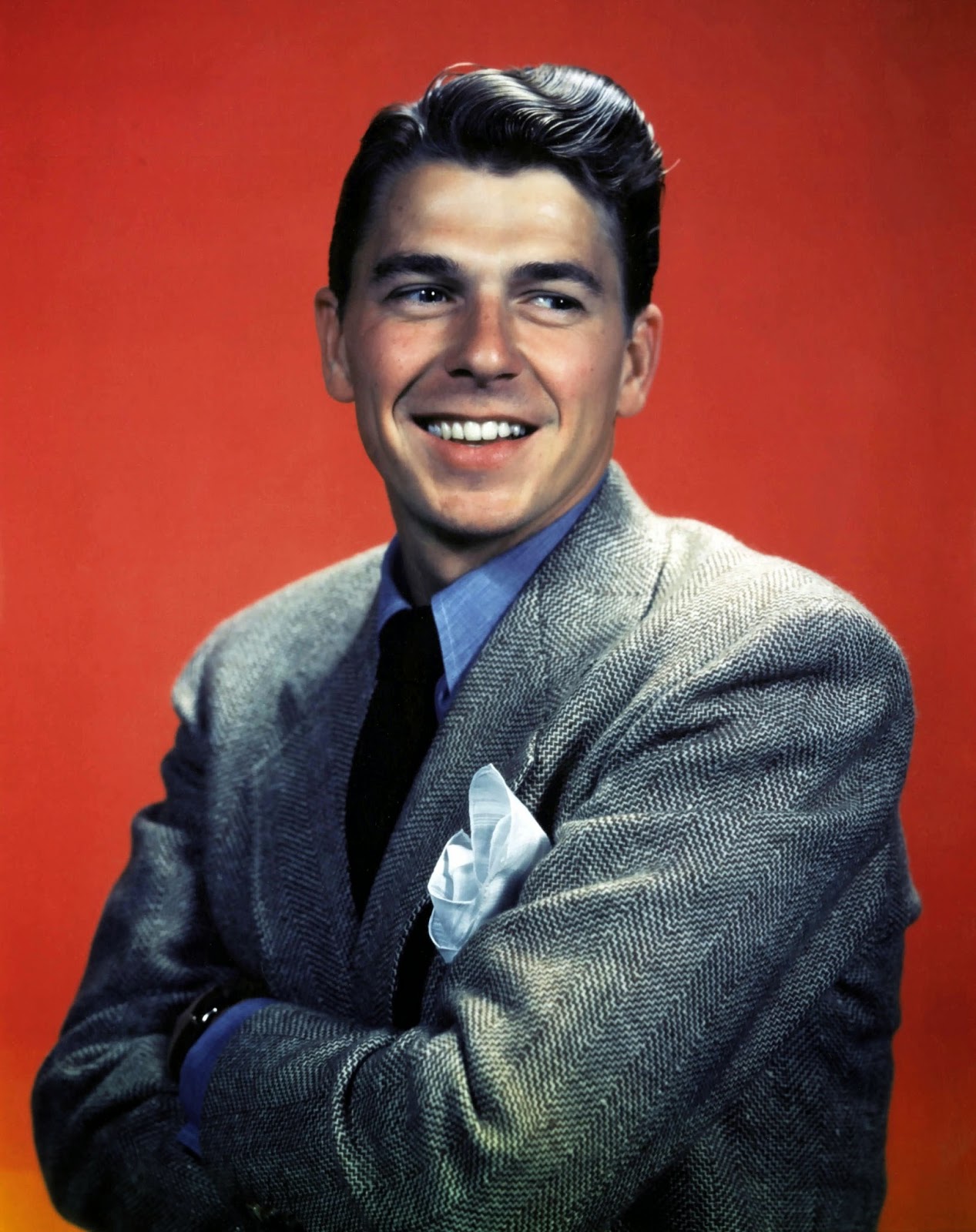
Reagan announced a War on Drugs in 1982, following concerns about the increasing crack epidemic. Though Nixon had previously declared a war on drugs, Reagan advocated more militant policies.

Reagan recognized the change in the direction of the Soviet leadership with Mikhail Gorbachev, and shifted to diplomacy, with a view to encourage the Soviet leader to pursue substantial arms agreements. Reagan's personal mission was to achieve "a world free of nuclear weapons", which he regarded as "totally irrational, totally inhumane, good for nothing but killing, possibly destructive of life on earth and civilization". He was able to start discussions on nuclear disarmament with General Secretary Gorbachev. Gorbachev and Reagan held four summit conferences between 1985 and 1988: the first in Geneva, Switzerland, the second in Reykjavík, Iceland, the third in Washington, D.C., and the fourth in Moscow. Reagan believed that if he could persuade the Soviets to allow for more democracy and free speech, this would lead to reform and the end of Communism.

Early in his presidency, Reagan started wearing a custom, technologically advanced hearing aid, first in his right ear and later in his left as well. His decision to go public in 1983 regarding his wearing the small, audio-amplifying device boosted their sales.

On July 13, 1985, Reagan underwent surgery at Bethesda Naval Hospital to remove cancerous polyps from his colon. He relinquished presidential power to the Vice President for eight hours in a similar procedure as outlined in the 25th Amendment, which he specifically avoided invoking. The surgery lasted just under three hours and was successful. Reagan resumed the powers of the presidency later that day. In August of that year, he underwent an operation to remove skin cancer cells from his nose. In October, additional skin cancer cells were detected on his nose and removed.

In January 1987, Reagan underwent surgery for an enlarged prostate which caused further worries about his health. No cancerous growths were found, however, and he was not sedated during the operation. In July of that year, aged 76, he underwent a third skin cancer operation on his nose.

After leaving office in 1989, the Reagans purchased a home in Bel Air, Los Angeles in addition to the Reagan Ranch in Santa Barbara. They regularly attended Bel Air Presbyterian Church and occasionally made appearances on behalf of the Republican Party; Reagan delivered a well-received speech at the 1992 Republican National Convention. Previously on November 4, 1991, the Ronald Reagan Presidential Library was dedicated and opened to the public. At the dedication ceremonies, five presidents were in attendance, as well as six first ladies, marking the first time that five presidents were gathered in the same location. Reagan continued publicly to speak in favor of a line-item veto; the Brady Bill; a constitutional amendment requiring a balanced budget; and the repeal of the 22nd Amendment, which prohibits anyone from serving more than two terms as president. In 1992 Reagan established the Ronald Reagan Freedom Award with the newly formed Ronald Reagan Presidential Foundation. His final public speech was on February 3, 1994, during a tribute to him in Washington, D.C., and his last major public appearance was at the funeral of Richard Nixon on April 27, 1994.

In August 1994, at the age of 83, Reagan was diagnosed with Alzheimer's disease, an incurable neurological disorder which destroys brain cells and ultimately causes death.

Reagan died of pneumonia, complicated by Alzheimer's disease at his home in Bel Air, California, on the afternoon of June 5, 2004. A short time after his death, Nancy Reagan released a statement saying, "My family and I would like the world to know that President Ronald Reagan has died after 10 years of Alzheimer's disease at 93 years of age. We appreciate everyone's prayers." President George W. Bush declared June 11 a National Day of Mourning, and international tributes came in from around the world. Reagan's body was taken to the Kingsley and Gates Funeral Home in Santa Monica, California later in the day, where well-wishers paid tribute by laying flowers and American flags in the grass. On June 7, his body was removed and taken to the Ronald Reagan Presidential Library, where a brief family funeral was held conducted by Pastor Michael Wenning. His body lay in repose in the Library lobby until June 9; over 100,000 people viewed the coffin.

His burial site is inscribed with the words he delivered at the opening of the Ronald Reagan Presidential Library: "I know in my heart that man is good, that what is right will always eventually triumph and that there is purpose and worth to each and every life."


Sources: Wikipedia

This work released through CC 3.0 BY-SA - Creative Commons